The Silent Paradigm Shift: The Web Has a New User
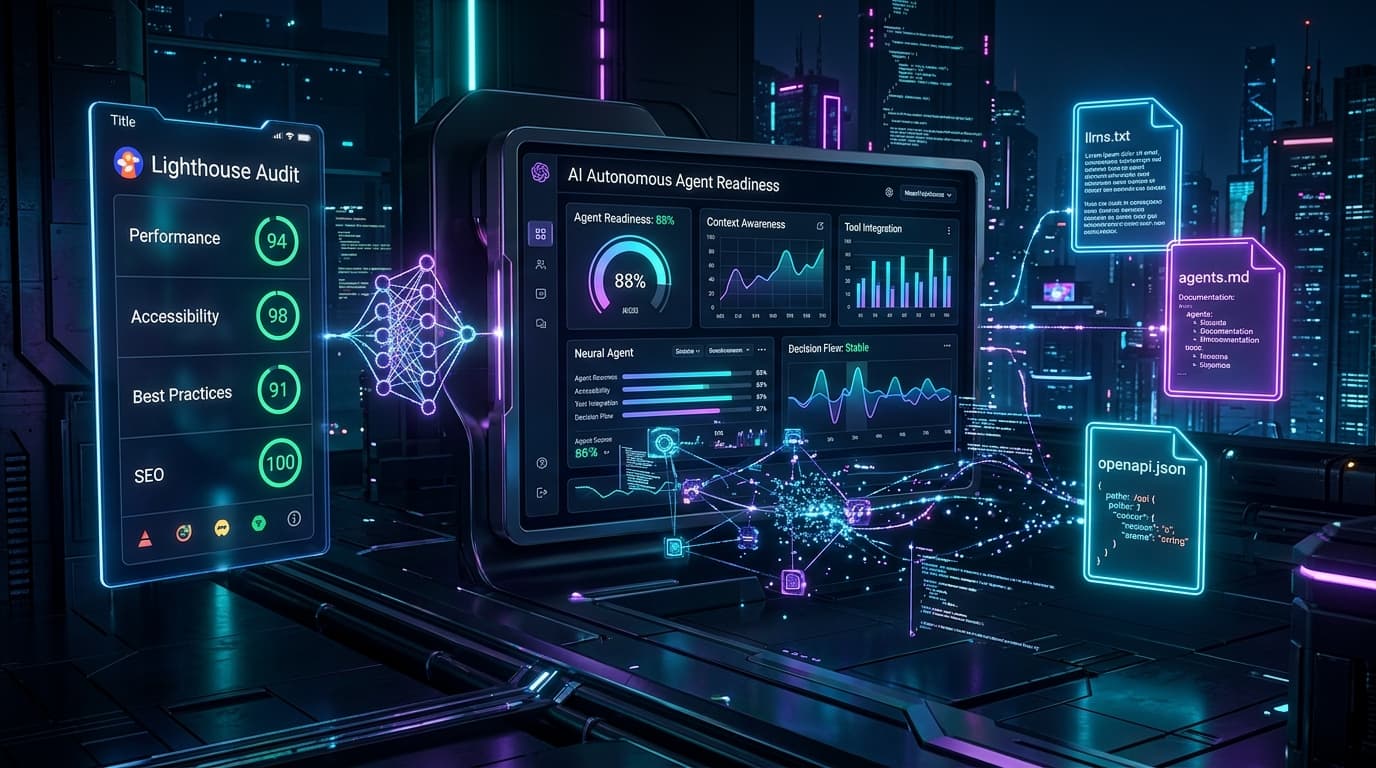
For three decades, web development revolved around a singular premise: optimizing for human visual consumption. We crafted layouts for retina screens, compressed responsive images, minimized Largest Contentful Paint (LCP), and chased the elusive 100/100 score on Google Lighthouse.
Search engines crawled our sites with dumb spiders that indexed keywords. We handed them a robots.txt to set boundaries and a sitemap.xml to guide their path. That was the contract.
In 2026, that contract has fundamentally broken.
Today, your website is frequently visited, parsed, and acted upon by autonomous AI agents — LLM web searchers (Perplexity, ChatGPT Search, Gemini), AI browser agents (Claude Computer Use, Operator), coding assistants (Antigravity, Cursor, Devin), and automated task executors. These agents don't gaze at CSS gradients or admire micro-interactions; they execute goal-directed loops, extract structured knowledge, and invoke API actions on behalf of humans.
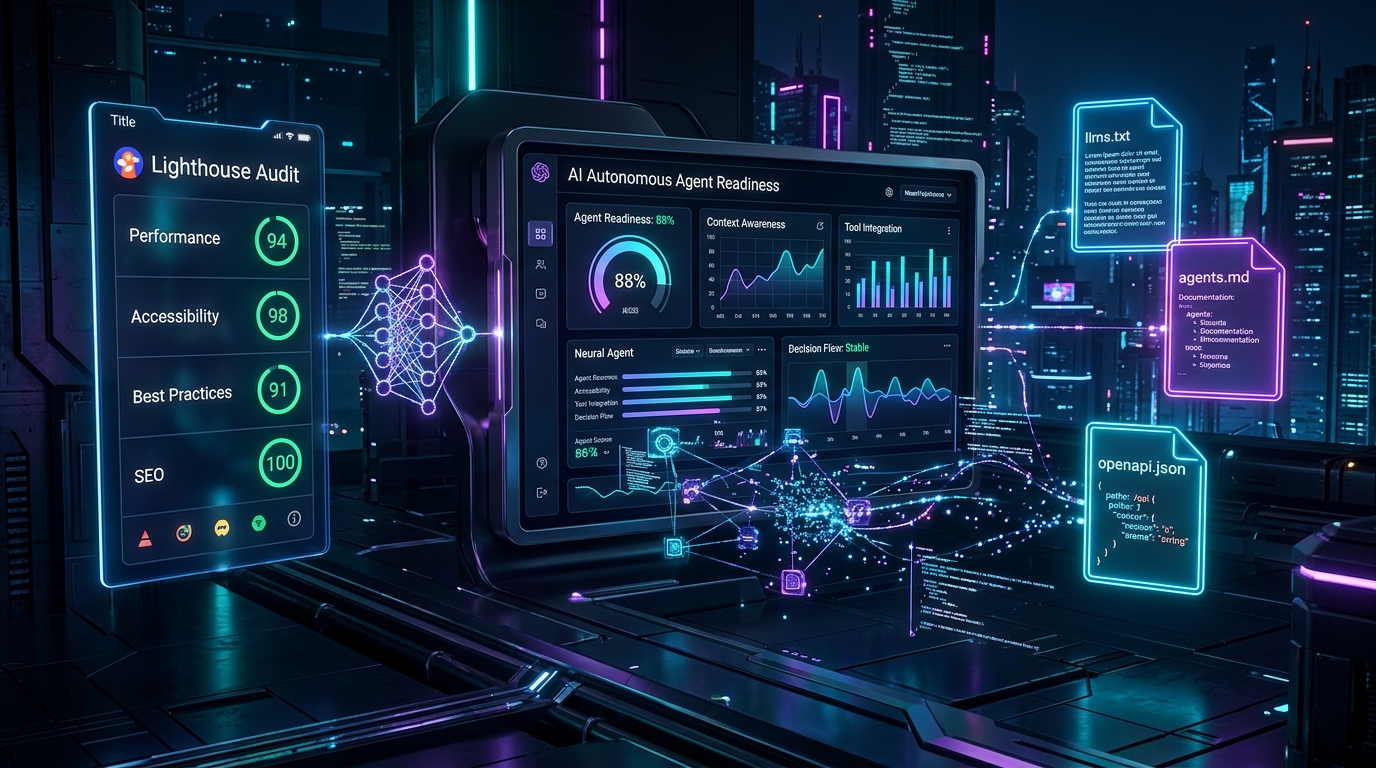
This reality has triggered the biggest architectural shift in frontend engineering since responsive web design: The transition from SEO to Agentic AI Readiness.
The Old Playbook vs. The Agentic Reality
Let's contrast where we were just a few years ago with where modern web engineering is today:
| Dimension | Traditional Web (SEO Era) | Agentic Web (2026 & Beyond) |
|---|---|---|
| Primary Consumer | Human eyes & Web crawlers (Googlebot) | Humans + Autonomous AI Agents & LLMs |
| Discovery Protocols | sitemap.xml, robots.txt, OpenGraph |
llms.txt, agents.md, /.well-known/ard.json |
| Interface Format | Heavy HTML / CSS DOM tree, Hydrated SPAs | Semantic Markdown, Tool Schemas, OpenAPI REST |
| Benchmark Metrics | Google Lighthouse (LCP, FID/INP, CLS, SEO) | Agent Readiness (is-agentic, ora.ai, Token Density) |
| Interaction Model | Clicking buttons, filling forms with mouse/touch | Function calling, WebMCP tools, headless transactions |
The Essential Agentic Manifest Stack
If you want your website or SaaS to be discoverable and reliably actionable by AI models, shipping a standard HTML bundle is no longer enough. Here is the modern manifest stack that modern web applications must implement:
1. /llms.txt and /llms-full.txt
Pioneered by Jeremy Howard and Answer.AI, llms.txt is to LLMs what sitemap.xml was to Google. When an agent lands on your domain, ingesting 500KB of Minified React JS and CSS markup wastes valuable context window tokens and introduces hallucination risks.
A llms.txt file is a standardized, clean Markdown file at the root of your domain providing concise context, high-level summaries, and direct links to documentation formatted in clean Markdown.
# Zuhaib Rashid - Portfolio & Agent Surface

## Context
Zuhaib Rashid is a Full Stack Developer specializing in React, Next.js, and TypeScript.

## Key Resources
- [Full Resume](/resume): Structured interactive CV
- [Open Source Projects](/projects): Portfolio of production web apps
- [Technical Blog](/blogs): Deep dives into modern architecture

## Machine Interfaces
- [OpenAPI Spec](/openapi.json): Programmatic API definitions
- [Agent Navigation](/agents.md): Autonomous agent operational rules
2. /agents.md (or AGENTS.md)
While robots.txt tells crawlers which paths they can or cannot index, agents.md provides operational guidance, constraints, rate limits, and behavioral guardrails for interactive agents.
It explicitly answers: How should an agent authenticate? What actions have side effects? Which endpoints are idempotent? Where is the rate limit ceiling?
3. /openapi.json & Structured Tool Calling
Instead of forcing vision models and DOM-parsers to figure out which input element inside an unlabelled <div> is the search bar, agentic web apps expose an openapi.json schema at their root. This allows any agent to directly invoke backend functions with zero UI ambiguity.
{
  "openapi": "3.0.0",
  "info": {
    "title": "Zuhaib Portfolio Agent API",
    "version": "1.0.0"
  },
  "paths": {
    "/api/github": {
      "get": {
        "summary": "Retrieve public GitHub metrics and star counts",
        "responses": {
          "200": {
            "description": "JSON payload containing live repo statistics"
          }
        }
      }
    }
  }
}
4. /.well-known/ard.json (Agent Resource Discovery)
Similar to /.well-known/security.txt or apple-app-site-association, ard.json allows AI browser extensions, agents, and IDEs to instantly discover capabilities without guessing URLs.
The Scoring Revolution: From Lighthouse to is-agentic & ora.ai
For over a decade, engineering teams celebrated when their Lighthouse score hit all green 100s. But a site with a 100/100 Lighthouse score can easily score a miserable 15% on an Agentic Audit.
Why? Because Lighthouse checks whether a human on a 4G mobile device can view rendered pixels within 2.5 seconds. It does not check if an LLM can understand your site's data flow, whether dynamic hydration breaks headless DOM parsers, or whether your forms are protected against bot hallucination.
⚡ The Rise of Agentic Audit Platforms
Platforms like is-agentic.org, ora.ai, and AI Readiness Indexers have emerged to test how seamlessly AI agents can crawl, reason about, and interact with your web application.
What Do Agentic Readiness Scores Actually Measure?
When an auditor like is-agentic or ora.ai tests your application, it evaluates four core pillars:
-
Context Density & Token Efficiency (Weight: ~30%):
How much meaningful information does an agent receive per token spent? If fetching a single blog post requires parsing 80KB of Tailwind classes and boilerplate React hydration script tags vs. a clean 3KB Markdown response, the token efficiency score drops drastically.
-
Actionability & Accessibility Tree (Weight: ~25%):
Does the site rely on
<div onClick={...}>or properly structured semantic HTML? Are buttons identifiable with deterministicaria-labelordata-testidattributes? Can headless browsers navigate forms without encountering hidden reCAPTCHA dead-ends? -
Machine Interface Discovery (Weight: ~25%):
Are
/llms.txt,/agents.md, and/openapi.jsonpresent, well-formed, and linked in response headers (such asLink: </llms.txt>; rel="llm-manifest")? -
Tool Calling Latency & Determinism (Weight: ~20%):
When an agent calls an API route, does it return predictable JSON with clear error schemas, or does it return unexpected HTML error pages that cause the LLM to crash?
How to Build an Agentic-First Next.js Web App
Let's look at how to implement these patterns in a modern Next.js (App Router) project.
Step 1: Dynamic /llms.txt Generation
Instead of hardcoding a static text file that gets outdated whenever you publish a blog, you can generate llms.txt dynamically from your database or content files:
// app/llms.txt/route.ts
import { blogs } from "@/lib/blogs";
import { projects } from "@/lib/projects-data";

export async function GET() {
  const content = `# Zuhaib Rashid - Portfolio Manifest

## Summary
Full Stack Developer portfolio featuring production web apps, engineering blogs, and public APIs.

## Projects
${projects.map((p) => `- [${p.title}](${p.liveUrl || p.githubUrl}): ${p.description}`).join("\n")}

## Recent Articles
${blogs.map((b) => `- [${b.title}](https://www.zuhaibrashid.com/blogs/${b.slug}): ${b.description}`).join("\n")}

## API Surfaces
- OpenAPI Specification: https://www.zuhaibrashid.com/openapi.json
- Agents Guide: https://www.zuhaibrashid.com/agents.md
`;

  return new Response(content, {
    headers: {
      "Content-Type": "text/plain; charset=utf-8",
      "Cache-Control": "public, s-maxage=3600, stale-while-revalidate=86400",
    },
  });
}
Step 2: Semantic Markup Over "Div Soup"
Vision-based agents and DOM scrapers struggle when everything is a <div>. Use native semantic HTML elements:
// ❌ Bad for AI Agents: Generic div soup
<div className="card" onClick={handleClick}>
  <div className="title">Read Article</div>
</div>

// ✅ Great for AI Agents & Humans: Semantic, accessible, actionable
<article aria-labelledby="post-heading">
  <h2 id="post-heading">From Lighthouse to Agentic Scores</h2>
  <Link href="/blogs/from-lighthouse-to-agentic-scores" aria-label="Read full article">
    Read Article
  </Link>
</article>
Step 3: Intelligent Bot Handling & Honeypots
Building for AI agents doesn't mean leaving your servers open to malicious spam. The best architecture combines open agent manifests for read operations with honeypot verification and rate limiting for mutating endpoints (like contact forms):
// app/api/send-email/route.ts
export async function POST(req: Request) {
  const { name, email, message, website } = await req.json();

  // Honeypot field: invisible to legitimate users, filled by naive bots
  if (website) {
    return Response.json({ success: true, message: "Sent" }); // Silent drop
  }

  // Process verified message with nodemailer...
}
The Future: The Dual-Interface Web
We are entering the era of the Dual-Interface Web. Your website must serve two equally important audiences:
- The Human User: Desires aesthetic beauty, micro-animations, intuitive ergonomics, and emotional connection.
- The AI Agent: Desires compact token density, clear schema definitions, deterministic tool calling, and high machine readability.
The developers and companies that build for both won't just rank higher on traditional Google search — they will be the primary sources cited, navigated, and utilized by the AI agents that are quickly becoming the front door to the entire internet.
Optimize your Lighthouse score for humans. Optimize your llms.txt and is-agentic score for AI. That is the new standard of excellence.